

Hip Impingement
Treatment for Pain and Limited Motion of Hip Impingement
Hip impingement, also known as femoroacetabular impingement (FAI), occurs when the bones of the hip joint do not fit together properly. This can cause friction during movement, leading to pain, stiffness, and reduced range of motion.
At Midwest Orthopedic and Musculoskeletal Alliance, our orthopedic specialists diagnose and treat hip impingement with a personalized, compassionate approach. We’re proud to help our patients return to comfortable movement and prevent long-term joint damage.
What is hip impingement?
The hip is a ball-and-socket joint, where the femoral head (ball) fits into the acetabulum (socket). In a healthy hip, these structures move smoothly against each other.
With hip impingement, abnormal contact between the ball and socket disrupts that smooth motion. Over time, this friction can damage cartilage and the labrum, leading to pain and increasing the risk of arthritis.

Types of Hip Impingement
Hip impingement is typically classified into three types:
Cam Impingement
The ball of the hip is not perfectly round, causing it to grind against the socket.
Pincer Impingement
The socket covers too much of the ball, leading to pinching during movement.
Combined Impingement
A combination of both cam and pincer types.
Understanding the type of impingement helps us guide the most effective treatment plan for your specific condition and symptoms.
What are the symptoms of hip impingement?
The signs of hip impingement often develop gradually and may worsen with activity. Common symptoms include:
- Pain in the groin or front of the hip
- Hip stiffness or limited range of motion
- Pain during activities like squatting, bending, or sitting for long periods
- Clicking, locking, or catching in the hip
- Pain that may radiate to the thigh, buttock, or lower back
Many patients notice symptoms during physical activity or after prolonged sitting.
What causes hip impingement?
The typical cause of hip impingement involves structural differences in the hip joint, including:
- Abnormal shape of the femoral head (ball)
- Extra bone growth on the ball or socket
- Over-coverage of the socket
- Developmental or genetic factors
- Repetitive stress from sports or activity
In some cases, these changes are present from birth, while others develop over time.
How is hip impingement diagnosed?
Diagnosis begins with our detailed evaluation of your symptoms and movement. Our care team may assess:
- Hip range of motion
- Pain with specific movements
- Functional limitations
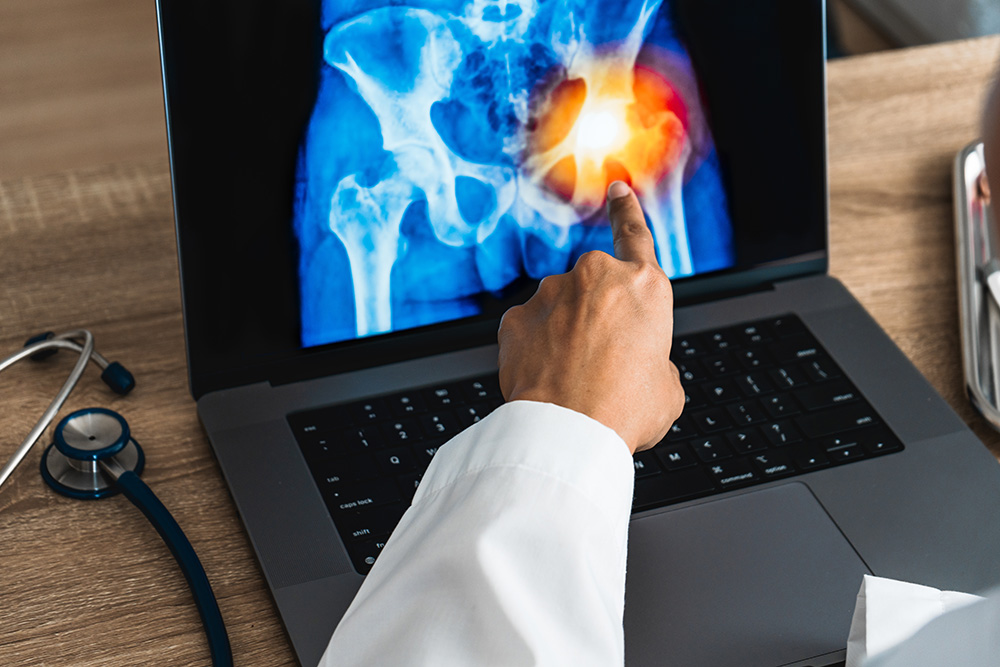
We often use imaging tests such as X-rays and MRI to confirm the diagnosis and evaluate cartilage or labral damage.
What are my options for hip impingement treatment?
Your treatment options will depend on the severity of your symptoms and the extent of joint damage.
Non-Surgical Treatment
Many of our patients find relief with conservative care, including:
- Activity modification
- Physical therapy to improve strength and mobility
- Anti-inflammatory medications
- Injections for pain relief
Surgical Treatment
If your symptoms persist, we may recommend surgery to correct the underlying issue. Common procedures include:
- Hip arthroscopy to reshape bone and repair damaged tissue
- Removal of excess bone causing impingement
- Labral repair
Whenever possible, we use minimally invasive techniques during the procedure to reduce your recovery time and preserve joint function.
The Importance of Early Treatment for Hip Impingement
It’s important that you are diagnosed and treated as soon as possible. Without treatment, hip impingement can lead to:
- Labral tears
- Cartilage damage
- Progressive joint degeneration
- Osteoarthritis
Early diagnosis and treatment can help protect the joint and delay or prevent more advanced conditions.
When to See a Specialist for Hip Pain and Limited Motion
You should seek professional evaluation if you experience:
- Persistent hip or groin pain
- Limited mobility or stiffness
- Pain that interferes with activity or daily life
- Symptoms that are not improving with rest
Frequently Asked Questions
What does hip impingement feel like?
Hip impingement often feels like a deep ache in the groin or front of the hip. Pain may worsen with bending, sitting, or physical activity. Some patients experience clicking or catching in the joint.
Can hip impingement go away on its own?
Mild symptoms may improve with rest and activity modification, but the underlying structural issue does not resolve on its own. Treatment focuses on managing symptoms and correcting the cause when needed.
Is hip impingement the same as a labral tear?
No, but they are closely related. Hip impingement can cause damage to the labrum, leading to a labral tear. Both conditions are often evaluated and treated together.
Do I need surgery for hip impingement?
Not always. Many patients improve with non-surgical treatments such as physical therapy and medication. Surgery is typically considered when symptoms persist or joint damage is present.
How long does it take to recover from hip impingement surgery?
Recovery varies, but many patients return to daily activities within a few months. Full return to sports or high-impact activity may take several months, depending on the procedure.
What activities make hip impingement worse?
Activities that involve deep hip bending or rotation can worsen symptoms. This includes squatting, running, or prolonged sitting.
Can hip impingement lead to arthritis?
Yes. Over time, repeated friction in the joint can damage cartilage and increase the risk of developing osteoarthritis if left untreated.
Find Relief from Hip Pain and Restore Your Mobility
If hip pain or reduced mobility is holding you back, call 414-384-6700 today to schedule a consultation with our orthopedic specialists at Midwest Orthopedic and Musculoskeletal Alliance in Southeastern Wisconsin. Early evaluation and treatment can make a big difference. We’ll create a personalized plan to help you feel more comfortable and move confidently again.
Layton Avenue Ste 102 - Orthopedic Clinic
3033 W Layton Avenue, Suite 102
Greenfield, WI 53221
414-384-6700
Layton Avenue Ste 160 - Orthopedic Clinic
2500 W Layton Avenue, Suite 160
Milwaukee, WI 53221
414-384-6700
N. Mayfair Road - Orthopedic Clinic
3077 North Mayfair Road, Suite 100
Wauwatosa, WI 53222
414-384-6700
27th Street - Orthopedic Clinic
9969 S. 27th Street, Suite 1100
Franklin, WI 53132
414-384-6700
Rawson Avenue - Orthopedic Clinic
3111 W. Rawson Avenue, Suite 200/205
Franklin, WI 53132
414-384-6700
Rawson Avenue - Pain Management Clinic
3111 W Rawson Avenue, Suite 235
Franklin, WI 53132
414-260-5544
N Port Washington Road - Pain Management Clinic
12831 N Port Washington Road
Mequon, WI 53092
414-260-5544
Washington Avenue - Pain Management Clinic
10180 Washington Avenue
Mount Pleasant, WI 53177
414-260-5544
Rawson Avenue - SmartScan Medical Imaging Center
3111 W. Rawson Avenue, Suite 105
Franklin, WI 53132
855-694-3300
Ballpark Drive - OrthoLazer Center
7044 South Ballpark Drive, Suite 202
Franklin, WI 53132
414-448-7001
Bluemound Road - OrthoLazer Center
17550 West Bluemound Road
Brookfield, WI 53045
262-289-9455
MOSH Brookfield Walk-In Clinic
17000L W. Bluemound Rd.
Brookfield, WI 53005
414-817-6750
MOSH Franklin Ortho Walk-In Clinic
7095 S. Ballpark Dr. Suite 100
Franklin, WI 53132
414-817-6620