

Kyphosis
Kyphosis Definition
People diagnosed with kyphosis typically have the appearance of poor posture. Often, as with Scheuermann’s disease, the rounded appearance of their back is not the result of poor posture but of a congenital condition. An orthopedist specializing in spinal disorders will help diagnose kyphosis, order tests to determine what kind you have, and determine the best treatments.
Kyphosis is a spinal disorder where the spine curves more than it should. A normal spine will have a forward curve measuring 20 degrees to 45 degrees. A patient with kyphosis will present an excessive outward curve of the upper back that is greater than 50 degrees. Unlike scoliosis, kyphosis refers only to a forward curvature of the spine.
Kyphosis can affect both adults and children, and is most often seen in one of the following three forms.
Quick Links
Types of Kyphosis
Age-Associated Hyperkyphosis
Common symptoms include:
- Pain
- Difficulty with movement and performing activities of daily life
- Stiffness
- Reduced height
Scheuermann's Kyphosis
Symptoms include poor posture and back pain. With Scheuermann’s kyphosis, early intervention is key — when treatment is initiated ahead of puberty while a child is still growing, an orthotic brace can straighten the spine and allow bone to grow in the vertebral spaces created by the bracing process.
Post-Traumatic Kyphosis
Common symptoms include:
- Spinal muscle fatigue
- Chronic swelling
- Progressive degeneration of the spine
- Pinched nerve(s)
- Problems with sitting balance with severe kyphosis
- Skin alterations in paraplegic patients
Diagnosing Kyphosis
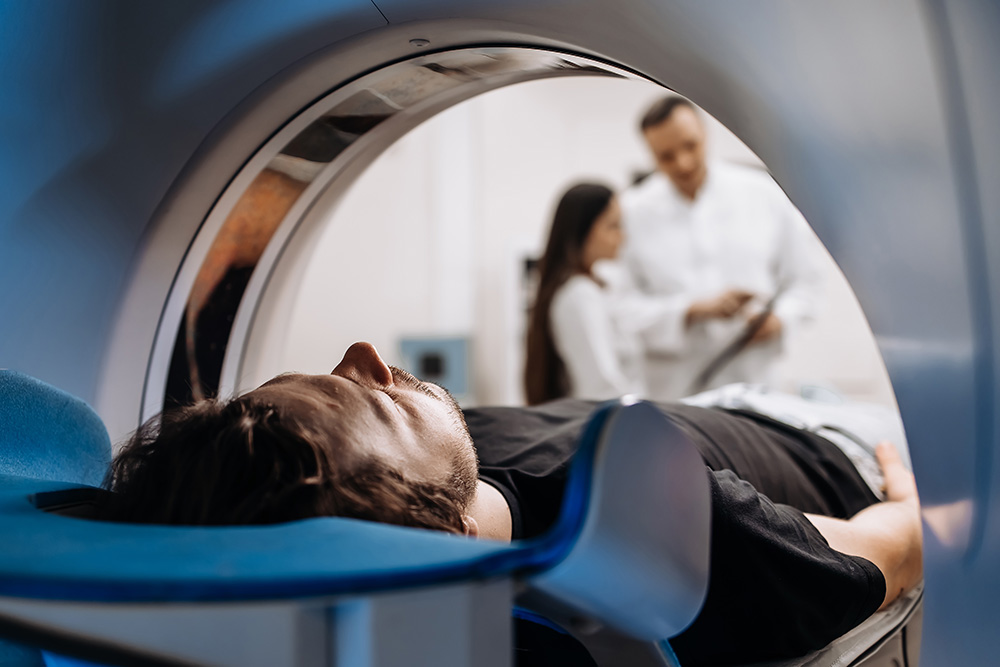
- Standing X-rays – Usually the gold standard in diagnosing kyphosis; elderly patients can be X-rayed lying on their backs
- MRI – Looks for compression of the nerves that could affect motor function
- CT scan – Provides enhanced imaging when X-ray is not adequate
- Biopsy – Can rule out underlying conditions like tumors or infection
Treatment for Kyphosis
Nonsurgical Treatments
- Non-steroidal anti-inflammatory medications (NSAIDs)
- Bracing or other orthotic devices
- Physical therapy and/or targeted daily exercise as directed by a clinician
Surgical Treatments
Spinal Fusion – Typically recommended for severe kyphosis with a forward curvature greater than 80°–90° accompanied by chronic back pain. Vertebrae are connected with two screws per vertebra and two rods. In most cases, surgery provides significant correction without the need for postoperative bracing. Patients are usually able to return to normal daily activities within four to six months.
Smith-Peterson Osteotomy – If Scheuermann’s kyphosis is not corrected by orthotics before puberty, the vertebral deformities become rigid and fixed. This procedure entails removing the bone in the back of the spine that connects the facet joint, enabling the spine to move to a more upright position.
Schedule a kyphosis consultation today
Contact Midwest Orthopedic and Musculoskeletal Alliance today at 414-384-6700 to schedule an evaluation. Our specialists in Southeastern Wisconsin will work with you to determine the best treatment path for your condition.
Layton Avenue Ste 102 - Orthopedic Clinic
3033 W Layton Avenue, Suite 102
Greenfield, WI 53221
414-384-6700
Layton Avenue Ste 160 - Orthopedic Clinic
2500 W Layton Avenue, Suite 160
Milwaukee, WI 53221
414-384-6700
N. Mayfair Road - Orthopedic Clinic
3077 North Mayfair Road, Suite 100
Wauwatosa, WI 53222
414-384-6700
27th Street - Orthopedic Clinic
9969 S. 27th Street, Suite 1100
Franklin, WI 53132
414-384-6700
Rawson Avenue - Orthopedic Clinic
3111 W. Rawson Avenue, Suite 200/205
Franklin, WI 53132
414-384-6700
Rawson Avenue - Pain Management Clinic
3111 W Rawson Avenue, Suite 235
Franklin, WI 53132
414-260-5544
N Port Washington Road - Pain Management Clinic
12831 N Port Washington Road
Mequon, WI 53092
414-260-5544
Washington Avenue - Pain Management Clinic
10180 Washington Avenue
Mount Pleasant, WI 53177
414-260-5544
Rawson Avenue - SmartScan Medical Imaging Center
3111 W. Rawson Avenue, Suite 105
Franklin, WI 53132
855-694-3300
Ballpark Drive - OrthoLazer Center
7044 South Ballpark Drive, Suite 202
Franklin, WI 53132
414-448-7001
Bluemound Road - OrthoLazer Center
17550 West Bluemound Road
Brookfield, WI 53045
262-289-9455
MOSH Brookfield Walk-In Clinic
17000L W. Bluemound Rd.
Brookfield, WI 53005
414-817-6750
MOSH Franklin Ortho Walk-In Clinic
7095 S. Ballpark Dr. Suite 100
Franklin, WI 53132
414-817-6620