

Knee Therapy & Rehabilitation
Knee replacement surgery is a complex procedure, and physical knee rehabilitation is crucial to a full recovery. In order for you to meet the goals of total knee surgery, you must take ownership of the rehabilitation process and work diligently on your own, as well as with your physical therapist, to achieve optimal clinical and functional results. The knee rehabilitation process
following total knee replacement surgery can be quite painful at times.
Your Orthopedic Surgeon and/or Physical Therapist will most likely assign a specific protocol to you, based on your rehabilitation needs. The following protocol is meant only to give you an idea of the kind of exercises you might do during rehabilitation. When in doubt about an exercise, follow the protocol outlined by your Surgeon and/or Physical Therapist.
After a knee injury or knee surgery, physical therapy at Midwest Orthopedic and Musculoskeletal Alliance helps you relieve joint pain, increase your range of motion and improve your strength.
Do I need knee therapy and rehab?
Take advantage of rehabilitation services at Midwest Orthopedic Specialty Hospital if you experience conditions such as:
- Arthritis
- Bursitis
- Chondromalacia, a type of runner’s knee
- Knee ligament injuries, including ACL, LCL, MCL or PCL tears
- Meniscus tear
- Patellar tendonitis, or jumper’s knee
Our rehabilitation program also fosters your recovery following your arthroscopic knee procedure, joint restoration surgery or minimally invasive, partial or total knee replacement procedure.
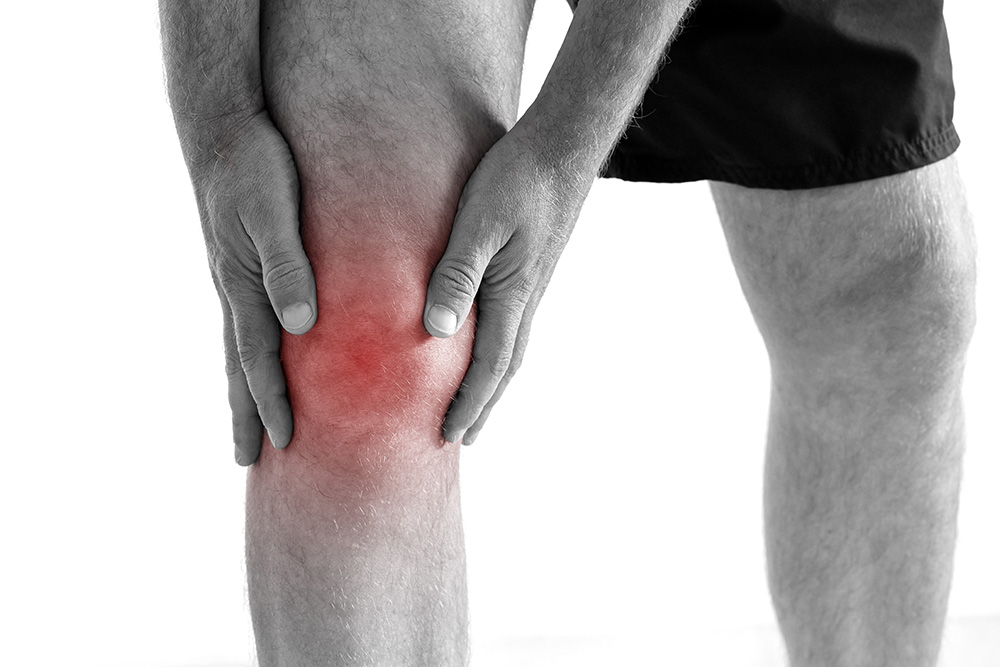
Personalized Rehabilitation Guidance
At Midwest Orthopedic and Musculoskeletal Alliance, you’ll meet with a skilled physical therapist who will ask you about your symptoms, examine your knee and perform a few basic tests to determine your joint’s strength and flexibility. You’ll get guidance in setting rehabilitation goals, such as reducing pain, returning to everyday activities or resuming sports. To improve your odds of a full recovery, you’ll discover stretches and exercises to practice at home.
Early Rehabilitation
Your knee rehabilitation program begins in the hospital after surgery. Early goals of knee rehabilitation in the hospital are to reduce knee stiffness and maximize post-operative range of motion as well as to help you get ready for discharge. The following steps may be taken to help maximize your range of motion following surgery.
- Strict adherence to the CPM protocol as prescribed by your surgeon
- Early physical therapy (day 1 or 2) to begin range of motion exercises and walking program
- Edema control to reduce swelling (ice, compression stocking, and elevation)
- Adequate pain control so you can tolerate the rehabilitation regimen
Outpatient Physical Therapy
Your outpatient knee rehabilitation program will consist of a variety of exercises designed to help you regain range of motion in the knee and build strength in the muscles which support the knee. You will follow an advanced strengthening program, adding weights as tolerated. A stationary cycle and walking program will be used to help increase range of motion and stamina, and an aquatic therapy program may be added as well.
Typical Home Exercises
Instructions in your home exercise program may include the exercises shown below. Consult your therapist regarding the appropriateness of the exercises and the number of reps.
Ankle Pumps
Flex ankle up and down.
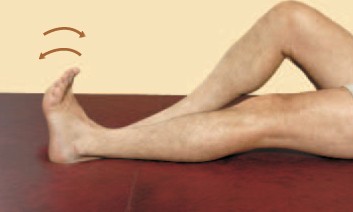
Heel Slides
Flex your hip and knee. Return knee to the straight position.
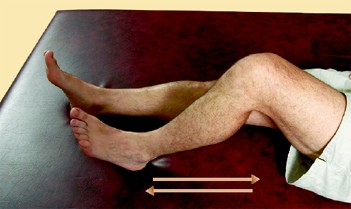
Quadriceps Sets
Tighten thigh muscles and hold for five seconds.
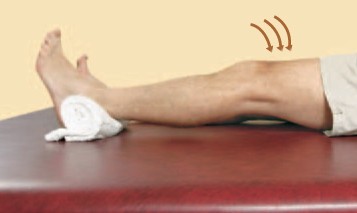
Leg Lifts
Raise leg six inches above the floor, keeping knee straight.
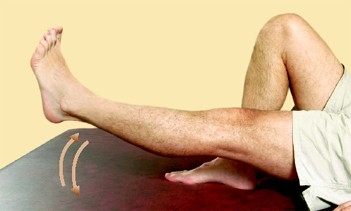
Knee Flexion Stretch
Place a towel under your heel. Pull your knee towards your chest. Hold your knee in this flexed position for 15-20 seconds. Return knee to the straight position.
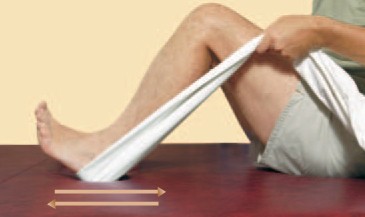
Knee Extension
Place a pillow under your knee. Lift your foot off the mat.
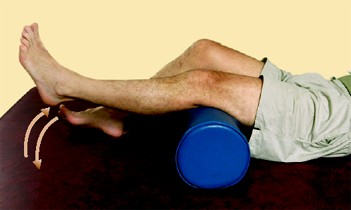
At Home
There are several things you can do at home to make your knee rehabilitation more successful. First of all, do the home exercise program as prescribed by your physical therapist. Next, follow these suggestions for daily activities:
Sitting
Use a chair with arms to help you rise to a standing position. Avoid sitting for longer than an hour if possible. If you must sit for a longer time, elevate the foot to avoid swelling.
Walking
Do not put weight through the joint until you’ve been cleared to do so by your surgeon.
Lifting
Do not lift more than ten pounds.
Showering
Showering is preferable to bathing because of difficulties getting in and out of the tub.
Exercising
Do the exercises that were recommended by your doctor and physical therapist. Go to physical therapy as prescribed and get advice from your therapist as to whether you’re doing the exercises correctly.
Getting Into a Car and Driving
Get into a car by sitting on the edge of the seat, then pulling in the legs and turning to face forward. Driving is usually not recommended for the first six weeks post-op. Talk with your surgeon about driving sooner.
Long-Term Knee Rehabilitation Goals
Once you’ve completed your knee rehabilitation therapy, you can expect a range of motion from 100-120 degrees of knee flexion, mild or no pain with walking or other functional activities, and independence with all activities of daily living.

Start Your Knee Rehabilitation Today
If you have questions about knee therapy and rehabilitation or would like to schedule a consultation, contact Midwest Orthopedic and Musculoskeletal Alliance today at 414-384-6700. Our team in Southeastern Wisconsin is here to guide you through every step of your recovery.
Layton Avenue Ste 102 - Orthopedic Clinic
3033 W Layton Avenue, Suite 102
Greenfield, WI 53221
414-384-6700
Layton Avenue Ste 160 - Orthopedic Clinic
2500 W Layton Avenue, Suite 160
Milwaukee, WI 53221
414-384-6700
N. Mayfair Road - Orthopedic Clinic
3077 North Mayfair Road, Suite 100
Wauwatosa, WI 53222
414-384-6700
27th Street - Orthopedic Clinic
9969 S. 27th Street, Suite 1100
Franklin, WI 53132
414-384-6700
Rawson Avenue - Orthopedic Clinic
3111 W. Rawson Avenue, Suite 200/205
Franklin, WI 53132
414-384-6700
Rawson Avenue - Pain Management Clinic
3111 W Rawson Avenue, Suite 235
Franklin, WI 53132
414-260-5544
N Port Washington Road - Pain Management Clinic
12831 N Port Washington Road
Mequon, WI 53092
414-260-5544
Washington Avenue - Pain Management Clinic
10180 Washington Avenue
Mount Pleasant, WI 53177
414-260-5544
Rawson Avenue - SmartScan Medical Imaging Center
3111 W. Rawson Avenue, Suite 105
Franklin, WI 53132
855-694-3300
Ballpark Drive - OrthoLazer Center
7044 South Ballpark Drive, Suite 202
Franklin, WI 53132
414-448-7001
Bluemound Road - OrthoLazer Center
17550 West Bluemound Road
Brookfield, WI 53045
262-289-9455
MOSH Brookfield Walk-In Clinic
17000L W. Bluemound Rd.
Brookfield, WI 53005
414-817-6750
MOSH Franklin Ortho Walk-In Clinic
7095 S. Ballpark Dr. Suite 100
Franklin, WI 53132
414-817-6620